
Supreme Court Case
McCleskey v. Kemp: Race, Statistics, and the Death Penalty
McCleskey v. Kemp rejected a constitutional challenge based on statewide evidence of racial disparity in Georgia capital cases. Here is what the 1987 ruling decided and why it still matters.
McCleskey v. Kemp is a Supreme Court case about a question that goes to the heart of capital punishment: what happens when careful evidence shows racial patterns in death sentencing, but no one can identify a single official who acted with bias in one particular case? In 1987, the Court answered that question in a way that still shapes the law.
The case did not ask whether a violent crime was serious. It asked whether a death sentence can stand when statewide evidence shows that race, especially the race of a victim, is connected to who receives death. That distinction matters. Accountability for grave harm and confidence in a fair process are not competing concerns. A system that takes punishment seriously has to take both seriously.
The short answer
In a 5-4 decision, the Supreme Court rejected Warren McCleskey’s constitutional challenge. The Court held that the statistical evidence did not show purposeful discrimination by decision-makers in his own case and did not prove that Georgia’s death-penalty system violated the Eighth Amendment.
The official decision is McCleskey v. Kemp, 481 U.S. 279, decided April 22, 1987. It remains important not because it settled every question about race and punishment, but because it set a demanding legal standard for people trying to use broad evidence of racial disparity to challenge an individual death sentence.
How the case reached the Court
Warren McCleskey, a Black man, was convicted in Georgia of armed robbery and the murder of a white police officer. A jury sentenced him to death. After his direct appeals, McCleskey challenged the sentence in federal court. His lawyers argued that Georgia’s capital-punishment system was shaped by unconstitutional racial discrimination and by an unacceptable risk of arbitrary punishment.
The challenge relied on research led by Professor David Baldus. The study examined more than 2,500 Georgia murder cases and assessed many details that could matter in a capital case, including the facts of the crime and the defendant’s background. The study found that cases involving white victims were substantially more likely to result in a death sentence than cases involving Black victims, even after the researchers accounted for other factors.
That evidence did not claim that every death sentence in Georgia was racially motivated. It raised a different and difficult question: if a system produces patterns that race helps explain, what must a person prove before a court will recognize a constitutional violation in a particular case?
What the Court decided
The majority rejected McCleskey’s Equal Protection claim because the study did not prove that a decision-maker in his particular case acted with discriminatory purpose. The Court treated statewide statistical disparity as different from proof that the prosecutor, jury, or another state official intentionally discriminated against McCleskey.
The Court also rejected his Eighth Amendment claim. It reasoned that Georgia’s capital-sentencing system included procedures intended to guide discretion and that the study did not establish an unconstitutional risk of arbitrary sentencing under the Court’s earlier death-penalty cases. The Court was also concerned that accepting McCleskey’s argument could invite comparable statistical challenges across the criminal legal system.
The decision did not say that the Baldus study was meaningless, or that race may be used in a capital case. Instead, it set a high bar for turning system-wide statistical evidence into a constitutional remedy for one person’s death sentence. The published opinion is essential reading because the majority and dissent agreed that the subject was grave, even as they disagreed sharply about what the Constitution required.
Why the Baldus study mattered
Capital cases involve many decisions: whether to charge a crime as capital, whether to seek death, which evidence to present, how to select a jury, and what sentence a jury returns. A study can test whether patterns appear across hundreds or thousands of those decisions. It cannot, by itself, read a person’s mind. That distinction became central to the case.
The research mattered because it tried to separate race from other explanations rather than simply compare raw totals. The Death Penalty Information Center describes the study as considering 230 factors involved in a state’s decision to seek death. Its findings made the race of the victim impossible to treat as a side issue in a debate about who faces the most permanent punishment.
Statistics do not replace testimony, case records, or direct proof. They can reveal a pattern that individual files may hide. In a system with discretion at many stages, that is valuable information for lawmakers, courts, reporters, and communities. The hard legal question in McCleskey was whether that kind of information was enough to require a remedy. The Court said no on the record before it.
The dissent and the disagreement that remains
Justice William Brennan wrote the principal dissent, joined by Justices Thurgood Marshall, Harry Blackmun, and John Paul Stevens. The dissent viewed the statistical evidence differently. It argued that the Eighth Amendment focuses on whether a punishment is being imposed in an arbitrary and unreliable way, not only on whether a particular official can be shown to have acted with conscious bias.
That disagreement is why the case has endured. The majority emphasized individualized proof and the limits of using statistics to challenge an individual sentence. The dissent emphasized that capital punishment is different because an execution cannot be corrected, and that patterns of racial disparity can be evidence of an unacceptable risk even without a written confession of bias.
Readers do not have to resolve every constitutional argument to understand the civic lesson. A legal system can recognize that serious crimes deserve serious responses while still asking whether the process values every victim’s life equally and treats every person with equal dignity.
Why the proof standard is so difficult
There is a practical difference between showing a pattern and proving the reason for one decision. A statewide study can show that some outcomes occur more often than others after researchers account for many variables. A courtroom claim about one person’s sentence may require proof tied to a particular prosecutor, juror, judge, or policy. The gap between those two kinds of proof is where McCleskey has had its greatest influence.
Direct evidence of discrimination is often rare. Decision-makers may never state an unlawful reason aloud, and a written record may capture only the final result. That is why statistical evidence has been important in other civil-rights contexts. It can identify a pattern that is unlikely to be explained by chance alone and point investigators toward questions that individual records do not answer on their own.
The majority did not say that every disparity is acceptable. It held that McCleskey’s evidence did not meet the constitutional test for his Equal Protection and Eighth Amendment claims. Critics of the ruling have argued that the test asks for a kind of individual proof that a system-wide problem is uniquely good at concealing. Supporters of a demanding standard worry about drawing conclusions from aggregate data where each case has its own facts. Both concerns are real, but the cost of getting the answer wrong is unusually high when the punishment is death.
That is also why this case belongs in public discussion, not only in legal textbooks. Data can tell a community where to look. It cannot decide every moral or legal question. Yet a community that ignores persistent patterns gives up one of the clearest tools it has for asking whether its institutions are treating people fairly.
What the case did not decide
McCleskey did not hold that racial discrimination is allowed. Intentional discrimination by a state actor remains unconstitutional. The decision also did not say that statistical evidence is useless in every legal setting. Different claims, laws, and records can require different kinds of proof.
It did not abolish the death penalty or decide that every death sentence is fair. Nor did it erase the evidence researchers, communities, and advocates continue to examine. The Coalition’s guide to racial bias in the death penalty explains why charging, sentencing, the race of a victim, and access to resources all belong in an honest discussion of fairness.
Most importantly, the decision did not reduce the human stakes to an academic dispute. Behind every data point is a victim, a family, a defendant, and a community living with the consequences of violence and punishment. The question is how to pursue accountability without building an irreversible penalty on a system that cannot reliably eliminate bias.
How McCleskey fits into death-penalty law
McCleskey sits beside the Supreme Court cases that define the modern death-penalty framework. In Furman v. Georgia, the Court stopped the death sentences before it because existing systems allowed arbitrary outcomes. In Gregg v. Georgia, the Court allowed revised statutes with procedures meant to narrow and guide sentencing.
McCleskey asks whether those safeguards can adequately address racial disparity. The majority concluded that Georgia’s procedures and the proof presented did not establish a constitutional violation. The dissent warned that a punishment so final cannot rest comfortably on a system that makes systemic discrimination exceptionally difficult to prove in court.
For a broader map, see the Coalition’s guide to Supreme Court death-penalty cases. It explains how decisions about arbitrariness, jury responsibility, age, disability, and sentencing facts all reflect the difficulty of making a permanent punishment depend on imperfect human institutions.
Why this matters in Western New York
New York does not have a working state death penalty. Federal law is separate, however, so a federal capital case can still arise in a New York courtroom. That makes national decisions about race, discretion, and constitutional safeguards relevant to local readers, even though New York state courts cannot impose death under the state’s invalidated statute.
The Coalition’s New York death penalty guide explains that difference. Its fact sheet offers sourced context on race, innocence, cost, deterrence, and death-row trends. Together, these resources make room for a conversation that takes violence seriously without assuming execution is the only form of accountability.
Life without parole can protect the public and impose a permanent sentence without making the state’s response irreversible. It also leaves room to correct a conviction or sentence if a court later finds new evidence, legal error, or discrimination. That possibility is not a technical loophole. It is a recognition of human limits.
How the Coalition can help
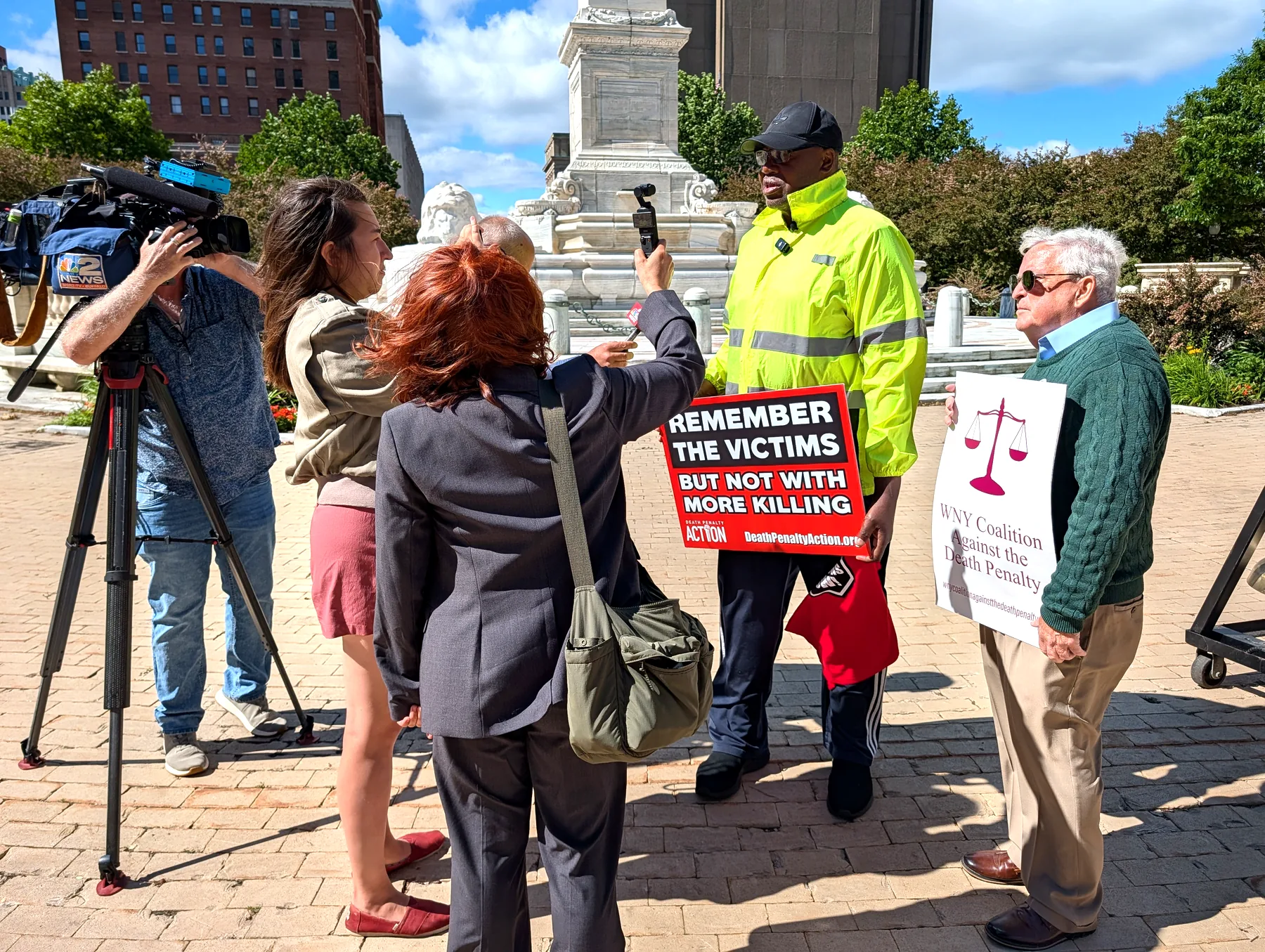
WNY Coalition Against the Death Penalty helps people discuss difficult legal questions with care and accuracy. The Coalition’s education resources and speaker program support classrooms, faith communities, and civic groups that want a grounded conversation about justice, safety, race, and accountability.
Readers can also explore Questions of Fact or find a way to participate through Get Involved. Rejecting execution does not require minimizing harm. It means refusing to give government an irreversible power when the evidence shows how hard it is to make that power fair.
Frequently asked questions
What did McCleskey v. Kemp decide?
The Supreme Court rejected Warren McCleskey’s challenge to his death sentence. The Court held that the statewide statistical evidence he presented did not prove that decision-makers in his own case had acted with discriminatory purpose, and it did not establish an Eighth Amendment violation.
What was the Baldus study?
The Baldus study examined more than 2,500 Georgia murder cases and considered many factors that could affect a capital case. It found a strong association between the race of the victim and the likelihood of a death sentence. McCleskey used the study to challenge how Georgia’s death penalty operated.
Did McCleskey v. Kemp say racial bias is legal?
No. The Court did not approve racial discrimination. Its decision addressed what proof was required for this particular constitutional challenge. The case is still widely discussed because it made broad statistical evidence difficult to use, by itself, to overturn an individual death sentence.
Why does this case matter in New York?
New York has no working state death penalty, but federal capital law is separate. The case also helps local readers understand why concerns about race, discretion, and proof remain central whenever a government considers an irreversible punishment.
Sources used in this article
This guide draws on the official United States Reports opinion in McCleskey v. Kemp, the Legal Information Institute’s text of the decision, and the Death Penalty Information Center’s research on the Baldus study and the ruling’s legacy.
Related reading
Public Safety
Racial Bias in the Death Penalty: What the Evidence Shows
Racial bias can shape capital cases through charging, sentencing, and the race of a victim. Here is what the research shows and why it matters.
New York Death Penalty Law
Furman v. Georgia: What Did the Court Decide?
Furman v. Georgia stopped death sentences under the laws then in force because the Court found arbitrary punishment. Here is what the 1972 ruling did and did not decide.

Public Safety
Death Penalty Wrongful Convictions: What Exonerations Show
People sentenced to death have later been exonerated. Here is what those cases show, why review matters, and why an execution cannot be corrected.