
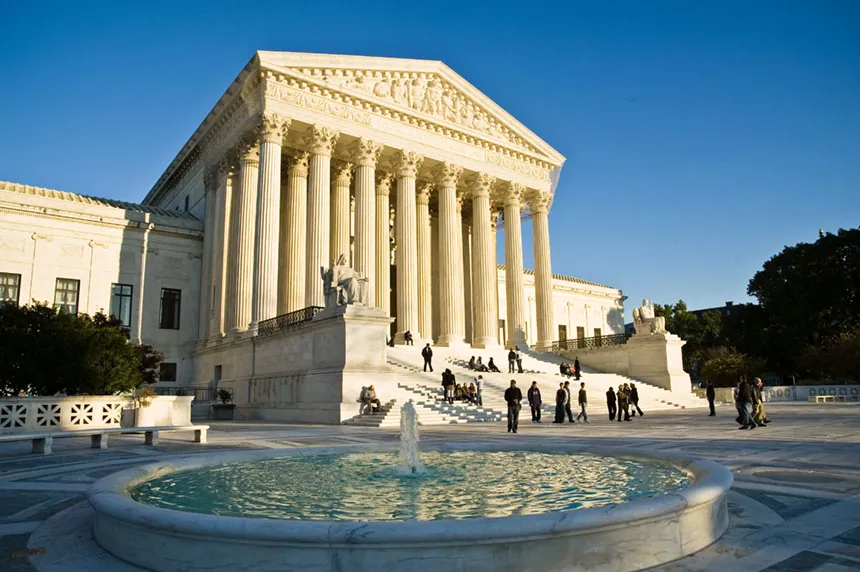
Roper v. Simmons, 543 U.S. 551 (2005), established that the Eighth Amendment prohibits the death penalty for crimes committed before a person turns 18. The Court held that executing juveniles is cruel and unusual punishment.
The 5–4 decision replaced the Court’s earlier 1989 ruling in Stanford v. Kentucky, which had allowed states to execute people who were minors when they committed their crimes.
Facts of the case
Christopher Simmons was sentenced to death in Missouri in 1993 for a crime committed when he was 17. His appeals in state and federal court were unsuccessful for years.
In 2002, the Missouri Supreme Court paused Simmons’s execution while the U.S. Supreme Court considered Atkins v. Virginia. After Atkins held that the execution of people with intellectual disabilities violated the Eighth Amendment, the Missouri court reconsidered whether the juvenile death penalty could still stand.
Why the Missouri court reconsidered
The Missouri court relied on the same principle discussed in Atkins: the Eighth Amendment’s meaning reflects evolving standards of decency. It concluded that the national view had changed since Stanford v. Kentucky in 1989.
Pointing to laws passed after Stanford that narrowed the death penalty, the court found a growing national consensus against executing people for crimes committed as minors. It ruled, by a 6–3 vote, that the juvenile death penalty was unconstitutional.
The constitutional question
Does executing people for crimes committed while they were minors violate the Eighth Amendment’s ban on cruel and unusual punishment, as applied to the states through the Fourteenth Amendment?
The Supreme Court’s 5–4 decision
Yes. In an opinion by Justice Anthony M. Kennedy, the Court held that standards of decency had evolved and that the death penalty is a disproportionate punishment for minors. The majority cited the consensus among state legislatures against the juvenile death penalty and the Court’s own judgment about minors’ diminished culpability.
The Court also noted overwhelming international opposition to the juvenile death penalty. Chief Justice William Rehnquist and Justices Antonin Scalia, Sandra Day O’Connor, and Clarence Thomas dissented.
Why age 18 matters
Justice Kennedy recognized that the differences between juveniles and adults do not disappear on a person’s eighteenth birthday. Still, the Court concluded that constitutional law needed a clear boundary: “However, a line must be drawn.”
Roper remains the controlling rule. A person cannot be sentenced to death in the United States for a crime committed before turning 18.