★★★★★
Prejean has become a leading advocate for the abolition of capital punishment in the United States. Her campaign was initiated following her correspondence and visits that she maintained with two convicted murderers. She began this ministry in 1982.
The Washington Post said that the book “presents a profound argument against capital punishment. It never minimizes what criminals have done in the past but by emphasizing that they, too, remain children of God, challenges America to prevent more victims in the future.” predicting that it “is destined to become the most influential anti–capital punishment statement since Albert Camus wrote ‘Reflections on the Guillotine‘ in 1957.

Dead Man Walking
In 1982, Sister Helen Prejean became the spiritual advisor to Patrick Sonnier. He was sentenced to death for killing two teenagers. This relationship marked the beginning of a profound transformation for Sister Helen. Sonnier, presented as a terrifying figure, soon revealed his vulnerabilities. While preparing for his execution, Sister Helen learned about his fears and regrets. The intimate bond formed during their conversations altered her perspective on life and death. She became painfully aware of the humanity tied to capital punishment. Sister Helen did not only connect with Sonnier; she forged ties with the victims’ families too. These families were battling their own grief while wrapped in a whirlwind of emotions. They oscillated between a desire for justice and feelings of helplessness. Sister Helen offered them her empathy, aiming to serve both sides of a harrowing narrative. This balancing act became a recurrent theme throughout her journey. As the execution day approached, the stakes grew ever higher, and questions of justice loomed large.
As the years passed, the impact of “Dead Man Walking” continued to grow. The book has inspired various adaptations in different media formats. Both a film and an opera bear witness to its enduring influence. In every iteration, Sister Helen’s message remains centralized. Her plea for understanding and compassion resonates with an ever-wider audience. “Dead Man Walking” serves as an invitation to challenge accepted societal views. Sister Helen Prejean’s journey leads to discussions around forgiveness, justice, and personal accountability. The emotional complexities she navigates urge readers to connect with their shared humanity. Her unwavering commitment to ending capital punishment propels the narrative forward. In an era marked by discord, her message remains poignant and vital. Sister Helen Prejean reminds us that all lives matter, even those deemed unworthy. Ultimately, “Dead Man Walking” is a heartfelt exploration of faith, hope, and redemption. It stands as a profound commentary on a system often viewed through a narrow lens.

A True Story of the Fight for Justice
Just Mercy by Bryan Stevenson is a powerful non-fiction book about his work as a lawyer with the Equal Justice Initiative (EJI) defending the wrongly condemned and marginalized in the U.S. justice system, focusing heavily on the case of Walter McMillian, a Black man wrongly convicted of murder in Alabama. The book serves as a searing indictment of racial bias and injustice in America, highlighting the potential for mercy and the need to fix a broken system
Average Rating: 4.8 out of 5 based on 150 reviews
After graduating from Harvard, Bryan Stevenson heads to Alabama to defend those wrongly condemned or those not afforded proper representation. One of his first cases is that of Walter McMillian, who is sentenced to die in 1987 for the murder of an 18-year-old girl, despite evidence proving his innocence. In the years that follow, Stevenson encounters racism and legal and political maneuverings as he tirelessly fights for McMillian’s life.

A landmark dissenting opinion arguing against the death penalty.
Does the death penalty violate the Constitution? In Against the Death Penalty, Justice Stephen Breyer argues that it does; that it is carried out unfairly and inconsistently and, thus, violates the ban on “”cruel and unusual punishments”” specified by the Eighth Amendment to the Constitution.
Today’s administration of the death penalty,” Breyer writes, involves three fundamental constitutional defects: (1) serious unreliability, (2) arbitrariness in application, and (3) unconscionably long delays that undermine the death penalty’s penological purpose. Perhaps as a result, (4) most places within the United States have abandoned its use.”
This volume contains Breyer’s dissent in the case of Glossip v. Gross, which involved an unsuccessful challenge to Oklahoma’s use of a lethal-injection drug because it might cause severe pain. Justice Breyer’s legal citations have been edited to make them understandable to a general audience, but the text retains the full force of his powerful argument that the time has come for the Supreme Court to revisit the constitutionality of the death penalty.
Breyer was joined in his dissent from the bench by Justice Ruth Bader Ginsburg. Their passionate argument has been cited by many legal experts including fellow Justice Antonin Scaliaas signaling an eventual Court ruling striking down the death penalty. A similar dissent in 1963 by Breyer’s mentor, Justice Arthur J. Goldberg, helped set the stage for a later ruling, imposing what turned out to be a four-year moratorium on executions.
A deeply moving work of narrative nonfiction on the tragic shootings at the Mother Emanuel AME church in Charleston, South Carolina from Pulitzer Prize-winning journalist Jennifer Berry Hawes.
On June 17, 2015, twelve members of the historically black Emanuel AME Church in Charleston, South Carolina welcomed a young white man to their evening Bible study. He arrived with a pistol, 88 bullets, and hopes of starting a race war. Dylann Roof’s massacre of nine innocents during their closing prayer horrified the nation. Two days later, some relatives of the dead stood at Roof’s hearing and said, “I forgive you.” That grace offered the country a hopeful ending to an awful story. But for the survivors and victims’ families, the journey had just begun.

In Grace Will Lead Us Home, Pulitzer Prize-winning journalist Jennifer Berry Hawes provides a definitive account of the tragedy’s aftermath. With unprecedented access to the grieving families and other key figures, Hawes offers a nuanced and moving portrait of the events and emotions that emerged in the massacre’s wake.
The two adult survivors of the shooting begin to make sense of their lives again. Rifts form between some of the victims’ families and the church. A group of relatives fights to end gun violence, capturing the attention of President Obama. And a city in the Deep South must confront its racist past. This is the story of how, beyond the headlines, a community of people begins to heal.
An unforgettable and deeply human portrait of grief, faith, and forgiveness, Grace Will Lead Us Home is destined to be a classic in the finest tradition of journalism.
Voices For an End to Capital Punishment


Desmond Tutu
“The death penalty is a step backward in the evolution of human rights.”

Pope Benedict Catholics are called not just to oppose the death penalty, but to actively work against it.

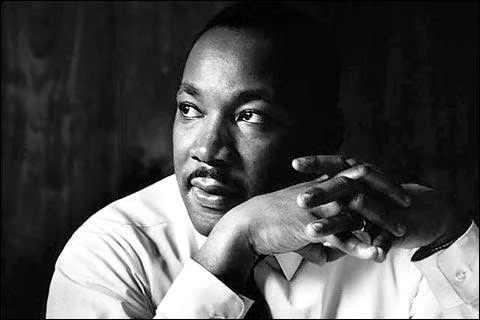
Rev. Martin Luther King, Jr.
“Returning hate for hate multiplies hate, adding deeper darkness to a night already devoid of stars. Darkness cannot drive out darkness; only light can do that. Hate cannot drive out hate; only love can do that. Hate multiplies hate, violence multiplies violence, and toughness multiplies toughness in a descending spiral of destruction.”
“An evil deed is not redeemed by an evil deed of retaliation,” she proclaimed. “Justice is never advanced in the taking of a human life. Morality is never upheld by a legalized murder.” Coretta Scott King

Desmond Tutu
“To take a life when a life has been lost is revenge, not justice.”

I’ve come to believe that the true measure of our commitment to justice, fairness, and equality cannot be measured by how we treat the rich, the respected, and the privileged among us. The true measure of our character is how we treat the poor, the disfavored, the accused, the incarcerated, and the condemned. – Bryan Stevenson Author Just Mercy

Frequently Asked Questions
What is the mission of the WNY Coalition?
The WNY Coalition Against the Death Penalty aims to end capital punishment through advocacy, education, and community engagement, highlighting the moral and spiritual costs of such punitive measures.
How can I get involved with the Coalition?
You can get involved by attending our events, volunteering your time, or donating to support our initiatives. We welcome individuals and organizations who share our commitment to social justice and human rights.
What resources does the Coalition provide?
We provide educational materials, community workshops, and support for those affected by capital punishment.
How can I support the Coalition?
You can support the Coalition by making a donation, spreading awareness about our mission, and participating in our advocacy efforts to end the death penalty.
What events does the Coalition host?
The Coalition hosts various events including educational workshops, community forums, and advocacy campaigns aimed at raising awareness about the issues surrounding capital punishment and promoting human rights.
Upcoming Events
JAN
15
Community Center
123 Main St, Buffalo, NY
10am – 12pm
FEB
20
City Hall
456 Elm St, Rochester, NY
1pm – 3pm
MAR
25
Local Library
789 Oak St, Syracuse, NY
2pm – 4pm

